
Best Practices for Peptide Storage
ALL ARTICLES AND PRODUCT INFORMATION PROVIDED ON THIS WEBSITE ARE FOR INFORMATIONAL AND EDUCATIONAL PURPOSES ONLY. The products offered on this website are furnished for in-vitro studies only. In-vitro studies (Latin: in glass) are performed outside of the body. These products are not medicines or drugs and have not been approved by the FDA to prevent, treat or cure any medical condition, ailment or disease. Bodily introduction of any kind into humans or animals is strictly forbidden by law.
Best Practices for Storing Peptides
Proper storage is key to maintaining the quality and stability of your peptides. Following best practices helps preserve their structure, prevent contamination or oxidation, and ensure the integrity of your research or results for the long term.
Short-Term Storage (Days to Months)
Once your peptides arrive, it’s important to keep them cold and protected from light.
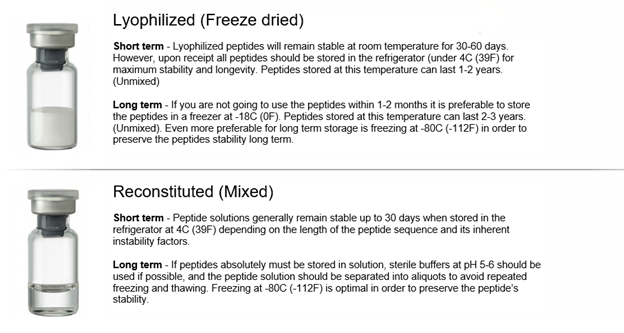
If you plan to use your peptides within the next few days, weeks, or months, refrigeration at or below 4°C (39°F) is generally sufficient.
Lyophilized (freeze-dried) peptides are typically stable at room temperature for several weeks. If they will be used within this timeframe, room temperature storage is acceptable.
Long-Term Storage (Several Months to Years)
For longer storage, peptides should be kept in a freezer at -80°C (-112°F). Deep freezing helps maintain peptide stability and prevents degradation over time.
Important Handling Tips
Avoid repeated freeze-thaw cycles, as this can compromise peptide integrity and lead to degradation.
Do not use frost-free freezers, since temperature fluctuations during automatic defrost cycles can affect peptide stability.
By following these storage recommendations, you can ensure your peptides remain stable, effective, and ready for use when you need them.
Peptide Handling and Contamination Prevention
To maintain peptide purity and performance, it’s essential to prevent contamination from air and moisture.
Avoiding Moisture Exposure
Moisture contamination most often occurs when a peptide is used immediately after being removed from the freezer. To prevent condensation, allow the peptide and its container to reach room temperature before opening. This simple step helps avoid moisture forming on the cold surfaces of the vial or peptide powder.
Limiting Air Exposure
Minimize a peptide’s contact with air as much as possible. Keep the container tightly sealed whenever it’s not in use. After removing the required amount, it’s best to reseal the vial under a dry, inert gas such as nitrogen or argon to protect the remaining peptide from oxidation. Peptides containing cysteine (C), methionine (M), or tryptophan (W) are particularly sensitive to oxidation and should be handled with extra care.
Aliquoting for Stability
Because repeated thawing, refreezing, and air exposure can significantly reduce peptide stability, many researchers pre-aliquot peptides into smaller vials. This allows you to open only what’s needed for each experiment or application—an effective method to preserve long-term integrity and minimize degradation.
Storing Peptides In Solution
Peptides stored in solution have a significantly shorter shelf life compared to their lyophilized (freeze-dried) form. In solution, they are also more susceptible to bacterial growth and chemical degradation. Peptides containing cysteine (Cys), methionine (Met), tryptophan (Trp), aspartic acid (Asp), glutamine (Gln), or N-terminal glutamic acid (Glu) tend to be especially unstable once dissolved.
If storage in solution is necessary, use a sterile buffer with a pH between 5 and 6, and divide the solution into aliquots to prevent repeated freeze-thaw cycles. This practice helps maintain peptide integrity over time.
As a general guideline, peptide solutions can remain stable for up to 30 days when refrigerated at 4°C (39°F). For peptides known to be less stable, freezing is recommended when not in use to help preserve their structure and functionality.
Storing Peptides in Containers
The quality of your storage container plays an important role in maintaining peptide stability and integrity. Containers should always be clean, clear, and structurally sound, as well as chemically resistant and appropriately sized for the amount of peptide being stored.
Container Materials
Both glass and plastic vials are commonly used for peptide storage. Plastic vials may be made from polystyrene or polypropylene, each with different properties:
Polystyrene vials are clear, offering good visibility, but they are less chemically resistant.
Polypropylene vials are more chemically resistant, though typically translucent rather than clear.
Best Practices
High-quality glass vials provide the best overall protection—offering strength, clarity, and chemical stability. However, plastic vials are often used for shipping to reduce the risk of breakage. Peptides can be safely transferred between plastic and glass containers as needed, ensuring flexibility while maintaining optimal storage conditions.
General Tips for Peptide Storage
When storing peptides, remember to:
- Store peptide in a cold, dry, dark place
- Avoid repeated freezing and thawing of peptide
- Avoid overexposure to the air
- Avoid light exposure
- Avoid storing peptides in solution long term
- Aliquot peptide according to experimental requirements